


Context
Overview
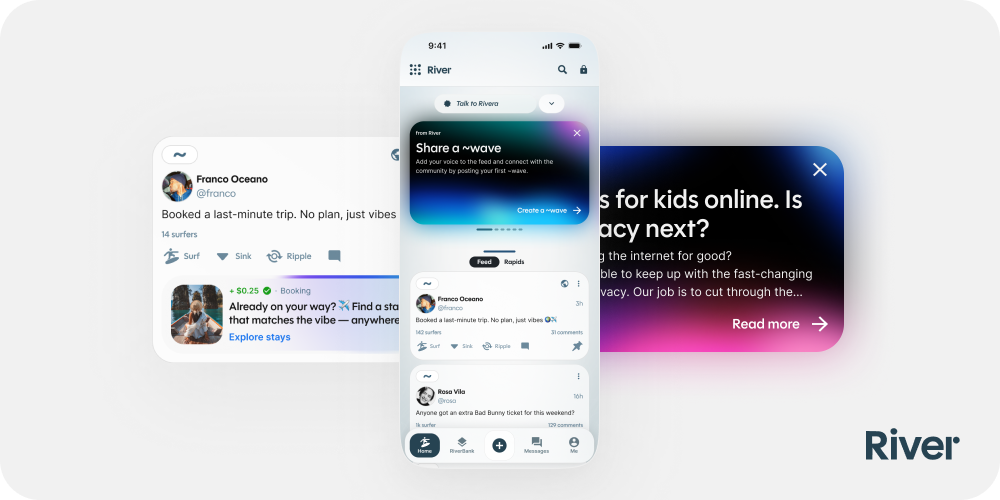
River flips the internet’s business model. Instead of harvesting user behavior in the dark, it makes data visible, controllable, and monetizable, returning value back to the user through RiverBank, SmartMatch, and a Gemini powered AI layer.
River is a social platform that learns from everything users do, including messaging, posting, searching, commenting, and AI queries, and stores that information as structured data points inside RiverBank. Users can explore what has been collected, edit it, delete it, and control how it is used through four control levels: Full Privacy, Anonymized Sharing, SmartMatch only, or Full Sharing.
River is live in beta, with end to end experiences built and available for users to register, explore, and interact with.
You can visit and sign up here:
www.river-social.com
My role
Lead Product Designer end-to-end.
I led UX and UI across River, from discovery and workshops to UX flows, wireframes, prototyping, visual design, design system work, developer handoff, ticket writing, and QA.
I collaborated closely with the PM, CEO and founders, marketing, and a cross functional engineering team including frontend, backend, and AI and LLM engineers.
Background
Most platforms monetize users through invisible data harvesting. People rarely understand what’s being collected, how it’s categorized, or how it’s being used, which makes personalization feel creepy, ads feel invasive or irrelevant, and the value exchange feel one-sided.
River was created to rebuild that relationship, giving users clear ownership over their data, making personalization transparent and controllable, and allowing users to earn from approved data usage instead of being exploited by it.
Target audience
River is designed for:
a) Heavy social users who generate constant interaction data and b) Privacy-conscious users who want transparency and control without losing modern social and AI experiences.
The core motivation is control first, with the option to earn money from their data when they choose.
Feature 1/4: Social Engine (Waves + Rapids)
River’s Social Engine gives users the full experience they already expect from modern platforms, including a social feed, short form video, reactions, reposting, and comments, while ensuring every interaction stays transparent and user owned.
Research and Ideation
Users already know social mechanics, but they do not know what those interactions generate behind the scenes. River’s goal was to keep the speed and familiarity of social platforms while solving what people increasingly distrust: hidden data collection and unclear personalization.
Design Process
We built River’s interaction language around familiar behaviors, rebranded into a coherent River native system.
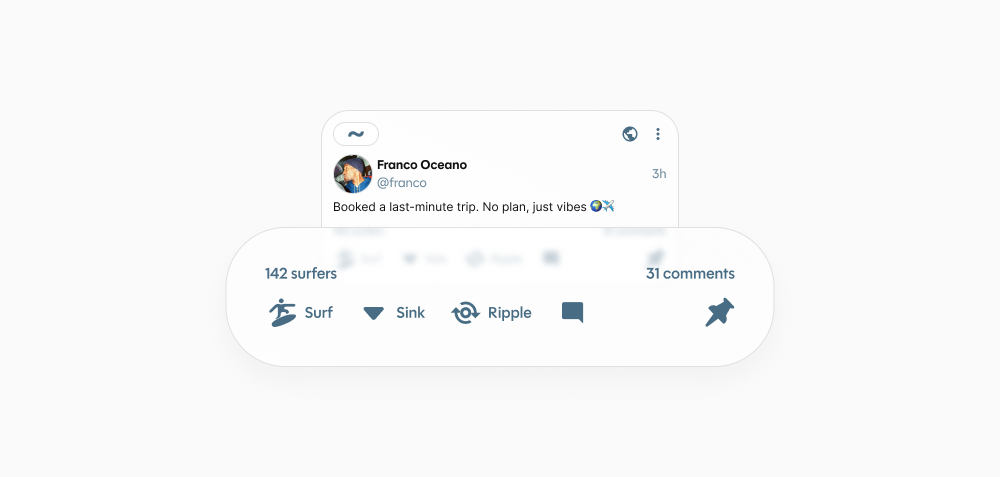
Posts are called Waves.
Short form video is called Rapids.
Engagement actions are consistent everywhere: Surf, Sink, Ripple, Comment.
We then layered in visible feedback for when data is created, without disrupting the experience.
Challenge
Build a social platform that feels like everything users already do online without overwhelming them, while introducing transparency and data control as a core part of the experience.
Solution
A recognizable feed system powered by a consistent interaction model across the platform, with subtle but clear signals that show users when their actions generate data.
Outcome
A cohesive social engine that feels intuitive, generates structured data signals for RiverBank, and creates natural moments for contextual SmartMatches
Why it matters: River stays fun and modern without hiding what it learns.
Feature 2/4: SmartMatch (Contextual Ads That Pay Users)
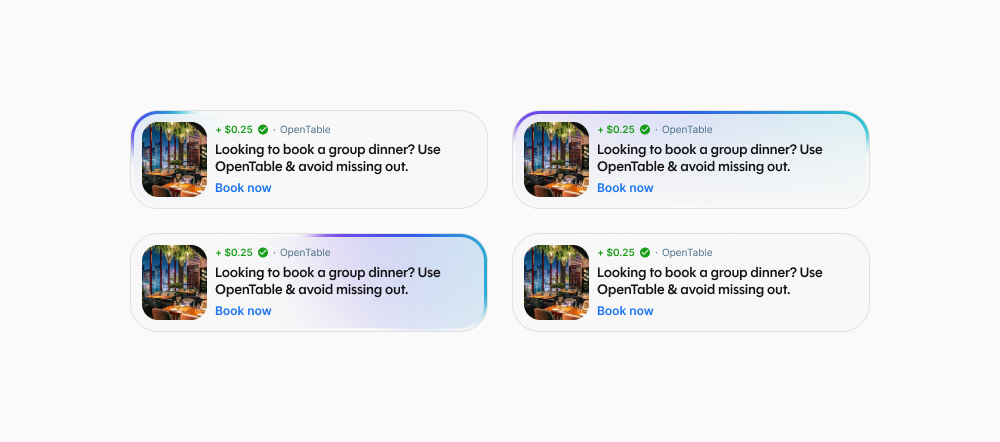
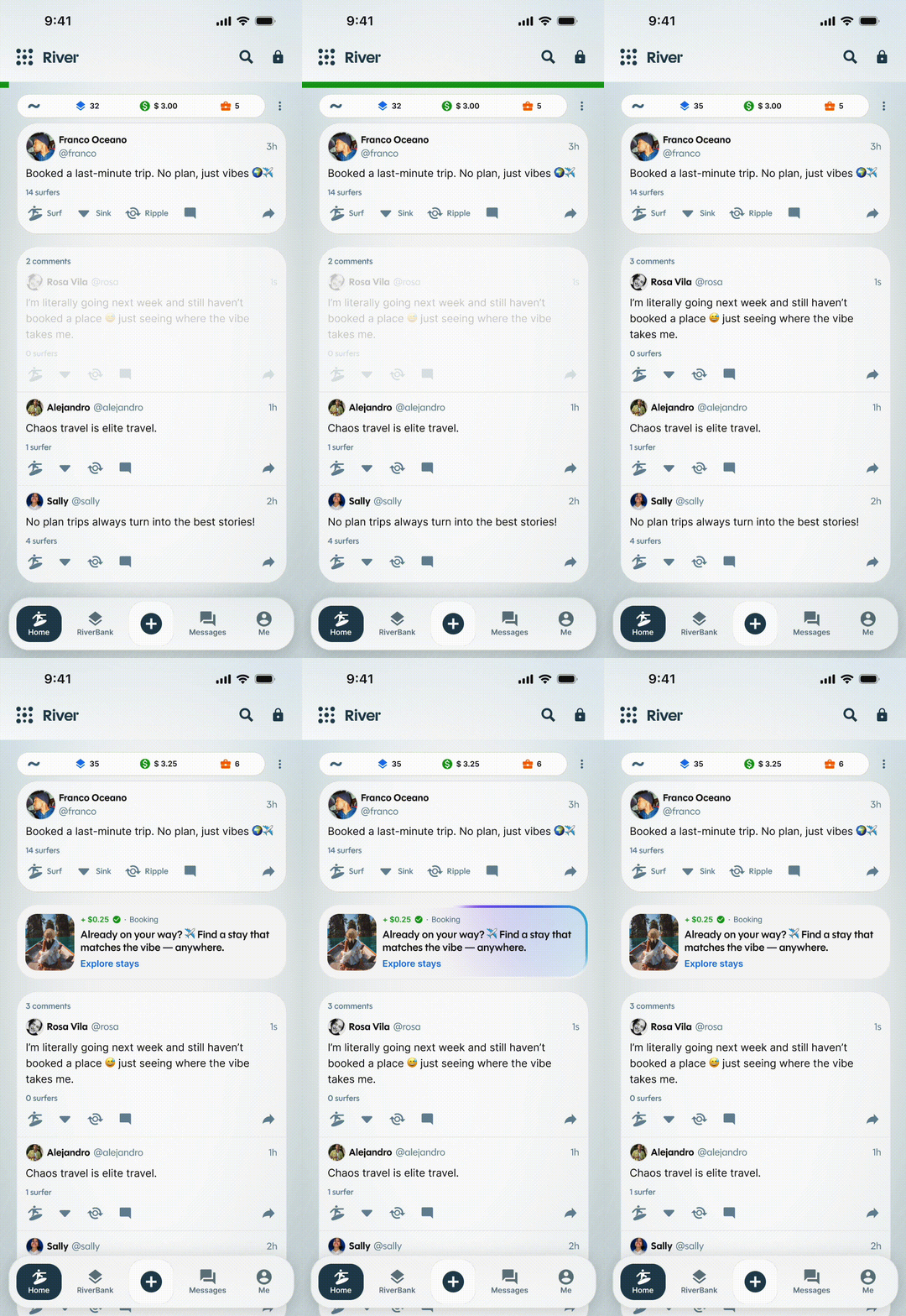
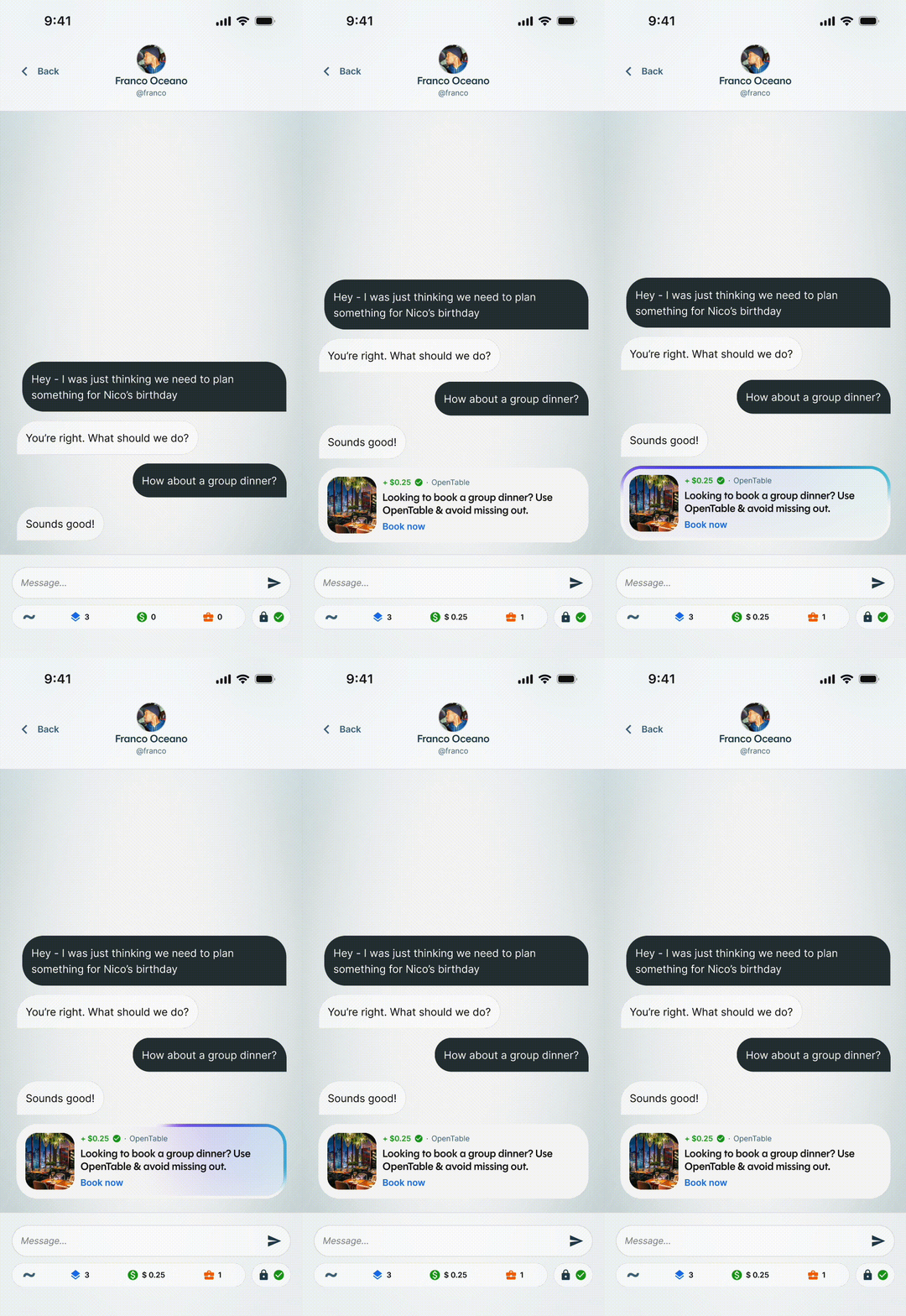
SmartMatch is River’s contextual advertising system, an offer that appears naturally inside feeds and chats using only data a user has approved. When a SmartMatch generates value, the user earns a cut.
Research and Ideation
Ads are personalized today, but the system is not transparent. Users do not know what data is being used or why they are seeing specific content. This makes ads feel creepy, irrelevant, and easy to ignore. At the same time, platforms monetize users while users receive no value, despite being the source of everything.
Design Process
SmartMatch was designed to feel native, helpful, and fair.
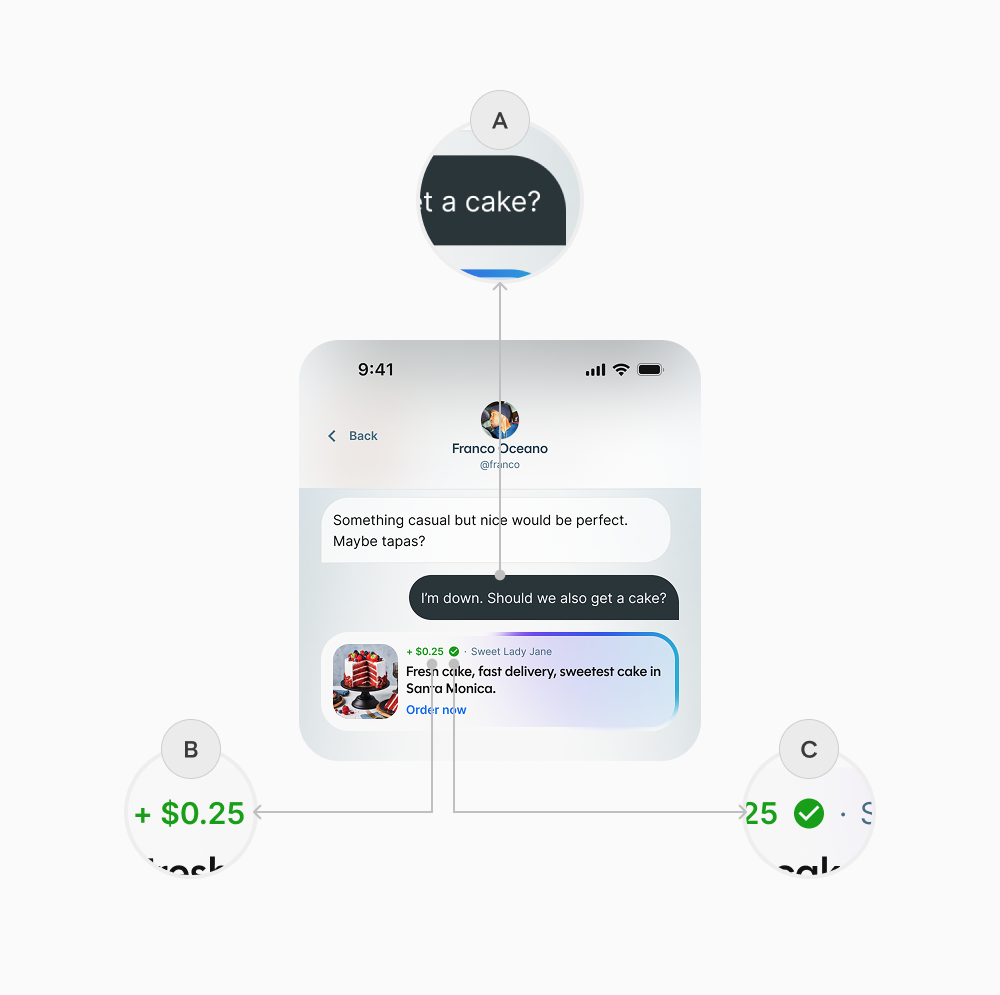
It is triggered by real time context, for example talking about cake leads to a cake related offer. (A)
It includes an earnings component that makes value exchange explicit. (B)
It is clear that it is based on user approved data and it respects control levels automatically. (C)
SmartMatch was designed to feel native, helpful, and fair.
It is triggered by real time context, for example talking about cake leads to a cake related offer. (A)
It includes an earnings component that makes value exchange explicit. (B)
It is clear that it is based on user approved data and it respects control levels automatically. (C)
SmartMatch does not rely only on a single interaction. It also considers broader contextual data the user has approved to share, such as location, social context, intent, allergies, budget, and other relevant preferences or signals, to ensure each match is accurate and appropriate.
Challenge
Fix a broken model where personalization feels invasive, relevance is inconsistent, and users do not benefit even though their data powers the system.
Solution
A contextual offer system that uses consented data, makes inputs understandable, allows fast control changes, and shares value back with the user.
Outcome
More relevant offers, higher intent engagement, reduced ad resistance, and a clearer economic loop between users and enterprises.
Why it matters: SmartMatch turns ads into transparent value instead of invisible extraction.
Feature 3/4: RiverBank + Control (Transparency and Governance)
RiverBank is the user’s data dashboard, a transparent database of everything River has learned. Users can filter, edit, delete, and control their data globally, by category, or per data point.
Research and Ideation
Platforms treat user data like a hidden asset. People rarely understand what is collected, what it becomes, or who profits from it. River needed to make data sovereignty feel accessible rather than technical.
Design Process
RiverBank was designed as a data ledger that stays understandable and actionable.
Users can explore a full list of data points.They can filter by category and control tier.
They can see metadata per item such as date created, control level, earnings, and usage.
They can delete data points.
They can open any item for a detailed breakdown, including enterprise engagement and SmartMatch history.
Control works at three levels:
- Global control for a default experience
- Category control for health, finance, behavior, personal, and other groups
- Data point control for fine tuning specific items
RiverBank also supports data monetization beyond advertising, enabling consent based and higher value use cases like AI or research datasets when users opt into anonymized or full sharing.
Challenge
Give users real ownership and transparency without making the experience overwhelming.
Solution
A transparent data system with multi level permissions and direct edit and delete actions built into the experience.
Outcome
Users can see what platforms normally hide, control their footprint, and understand the value being generated from their data.
Why it matters: RiverBank turns ownership into something usable and real.
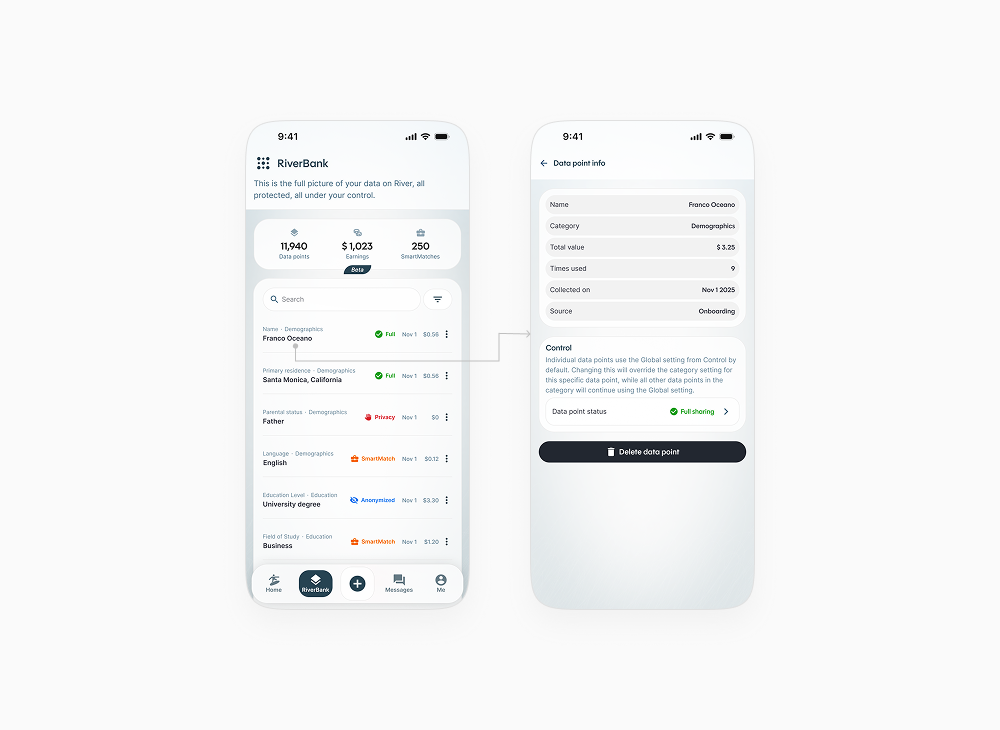
RiverBank and Data point details.
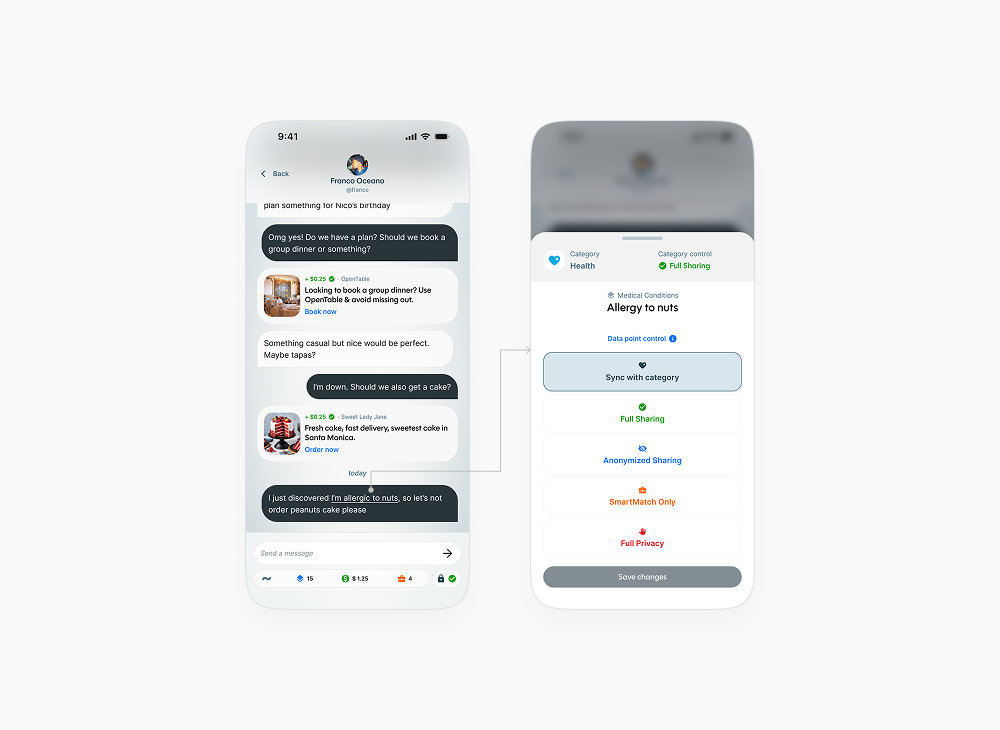
Underlined data point and granular control options.
Feature 4/4: Rivera + Insights (AI That Feels Natural)
Rivera is River’s AI assistant, powered by Gemini, designed to feel familiar while staying connected to user owned data. It supports fast chat responses and structured BentoBox outputs for deeper requests. Alongside it, River surfaces insights proactively through a carousel and contextual moments across the app.
Research and Ideation
AI is powerful but often disconnected from daily behavior. Users have to leave what they are doing or open separate tools. River’s goal was to make AI feel native to the platform and useful without becoming intrusive.
Design Process
We built AI as a two way system.
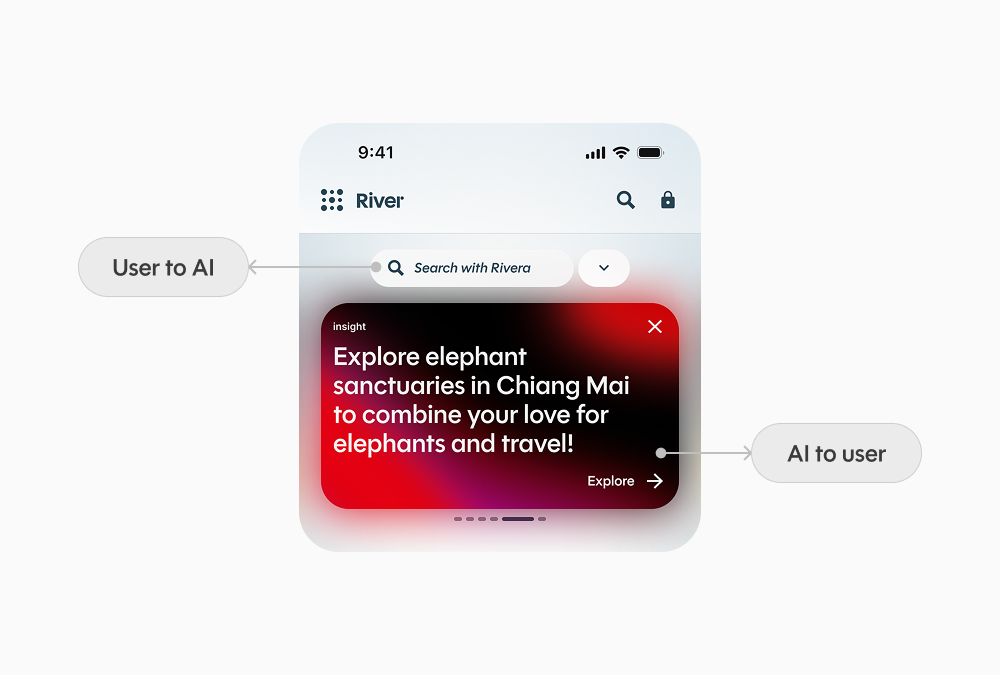
User to AI (Rivera)
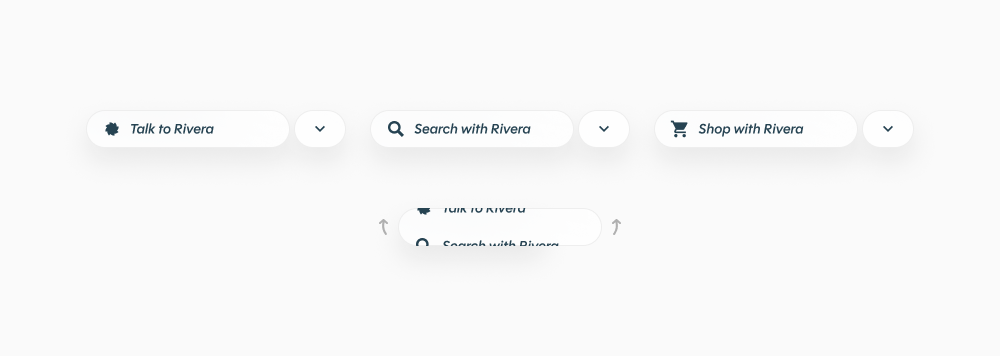
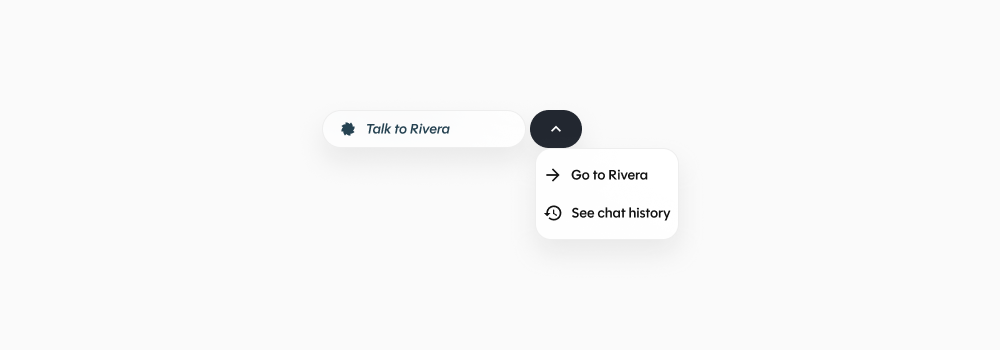
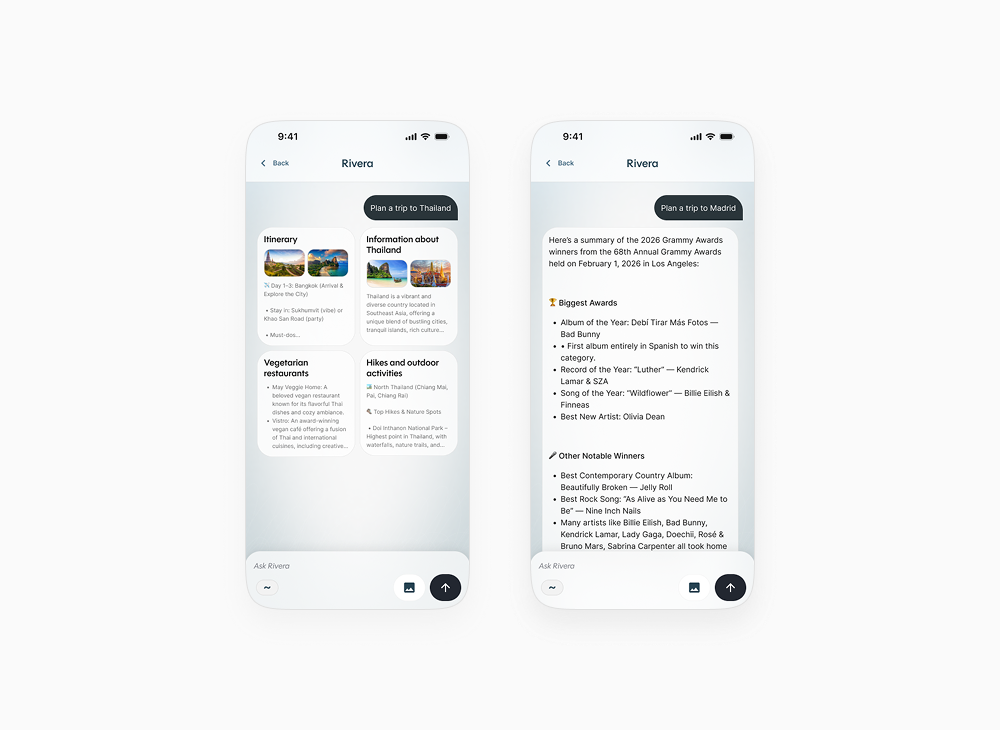
Accessible directly from the top of the feed, Rivera allows users to search or ask anything without interrupting their browsing flow. Responses adapt based on complexity. Simple chat for quick questions. BentoBox structure for multi step needs like planning.
AI to User (Insights)
The Insights layer proactively delivers useful information like reminders, trivia, and contextual assistance based on user behavior and preferences, turning River into an ongoing assistant rather than just a platform.
These insights are primarily surfaced through a carousel on the main feed that updates proactively, acting as a lightweight daily checkpoint for the user.
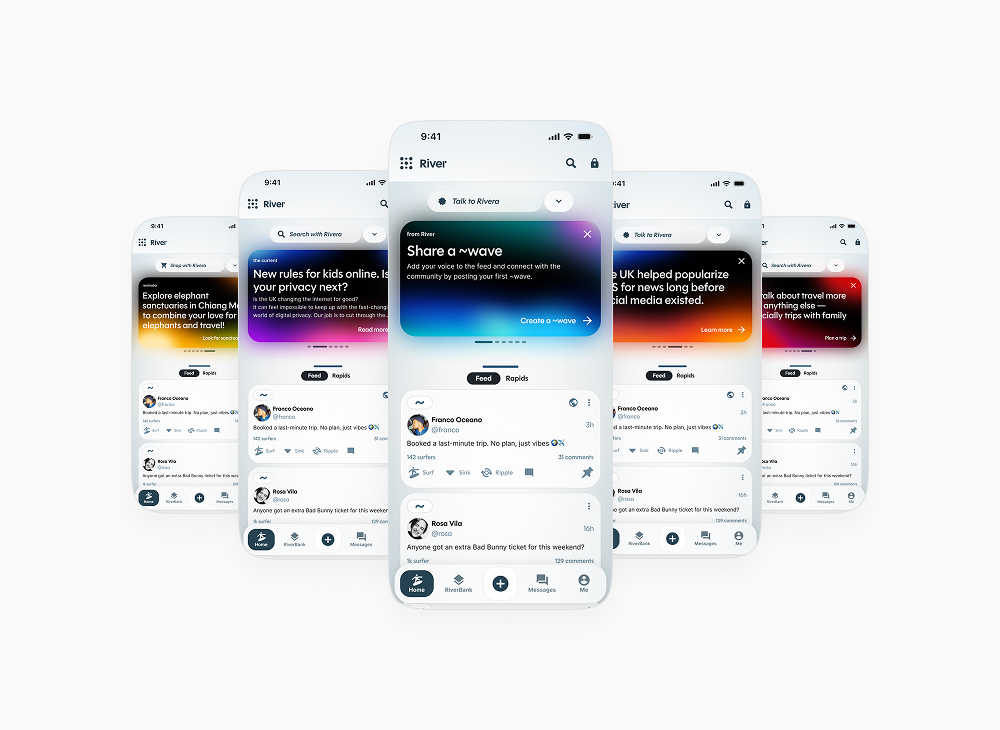
Insights also expand into other parts of the experience, such as Waves, messages, and Rivera queries, where they appear only when relevant. Users can tap an insight to open a small helper that provides more detail without pulling them out of the current flow, keeping the experience smooth and uninterrupted.
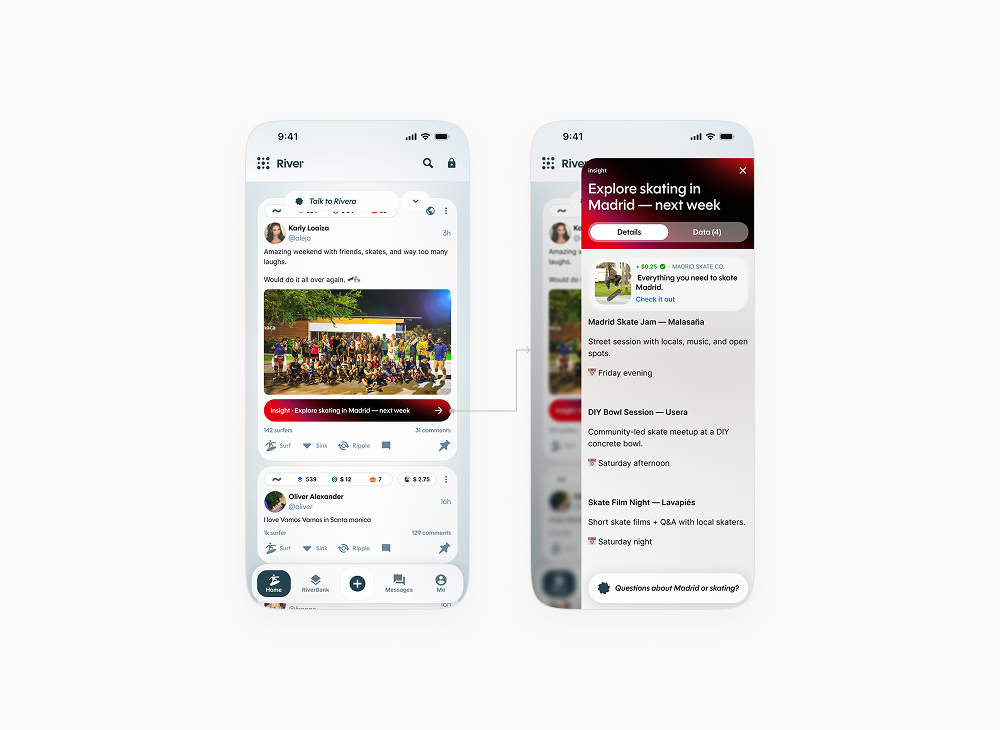
Every interaction continues to create data points transparently while respecting user control levels and allowing SmartMatch only when relevant.
Challenge
Make AI feel natural inside a social platform without overwhelming users or reinventing behaviors people already understand.
Solution
A bilateral AI experience with Rivera for instant access and Insights for proactive support, with flexible outputs depending on request type.
Outcome
River becomes more than social and monetization. It becomes a personal hub where user owned data creates meaningful experiences.
Why it matters: users benefit directly from personalization, not just enterprises.
Conclusions
The biggest challenge was combining everything users do online into one cohesive ecosystem, including social interactions, private messaging, AI interactions, monetization, plus transparency and control across everything, without making the product feel overwhelming.
What I Am Proud Of
River’s UI is modern, on brand, and genuinely easy to use, and we have received strong feedback from real beta users. More importantly, this project addresses a global problem. Lack of transparency and misuse of personal data affects everyone, and River is designed to push the internet toward a fairer and more user owned future.
Key Learnings
Users are actively craving transparency and control.
Trust must live inside the interface, not inside policies.
Familiar interaction patterns reduce cognitive load in complex systems.
Ownership needs multiple levels to work for real users.
What Is Next
River continues evolving through beta, with a strong push toward a full iOS experience and ongoing iteration across core features. Beyond the social platform itself, the team is actively exploring how River’s transparency, control, and data sovereignty layer can power experiences outside of traditional social media.
User feedback has validated that people are craving this level of visibility, permission, and personalization with their own data. That opens up a much broader opportunity beyond social, including new platforms, product types, and enterprise partnerships where user-approved data can enable more meaningful, relevant, and respectful experiences.
River is currently exploring these new directions, testing different applications of the technology, and working with enterprises to extend this model across the internet, not just within a single social product.

Let's talk
If you’re working on a complex product and need a designer who can take it from ambiguity to delivery, I’m open to conversations.

soyandresgar@gmail.com

Based in Colombia. Working remotely
